Eghersis is a transliteration of the Greek word, εγερσις, which has the meaning of being roused to life. Thus, it is my hope that what you find on this blog will empower, arouse, stimulate, excite, and animate your life--your soul, your spirit--the wholeness of who you are.
The deep breath of Holy Week is building momentum. It is the silence before a hailstorm. It is the darkness before a downpour. I feel the momentum building in my soul, and I fear the rain of the next two days.
I fear the emotions that will rise when the colors of the altar are removed and the candles extinguished and emptiness and darkness fill the sanctuary. It will be as though the life of the Lenten season has withered and died. And that is the whole point of this week--to come to the end of it in mourning, but I fear that I will cry. I will cry as if there is no hope, no life, no resurrection. And in that moment, what I will truly be fearing is that hopelessness, that lifelessness.
But I embrace this fear, this moment of hopelessness and lifelessness. I embrace it because it brings a gift. It brings the gift of One Who Is Resurrected. And this Resurrected One brings a new kind of hope and a new kind of life. It brings the dawning of not just a new day but a new week. The sun after the dark clouds. The rainbow after the hailstones.
So breathe deeply, O Holy Week, I embrace the end in order to find the beginning.
Throughout this Lenten season, something that Jesus said has been coming back to me. "Do to others what you want them to do to you." This has been begging a hard question for me. What do I want others to do to me? Do I always want others to be nice, to be kind, to be thoughtful? I think I do, but then I wonder about the truth.
Do I want to know the truth? Is telling the truth always nice, kind, thoughtful? Do I want to be left to my own devices without interference? Do I want what is difficult and challenging? And if so, how do I want it presented? And would others want it presented in the same way that I would?
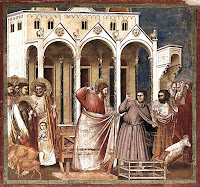
And then there is Jesus as he calls some people "white-washed tombs" and "dirty cups." Does this mean that it's okay to be a bit rude with the truth as long as I am willing to receive the same if necessary? And then there is that scandalous scene in the temple where Jesus is throwing people's things around and brandishing a whip. I wonder if any of the disciples were thinking about "Do to others . . . in that moment of shocking behavior?
I know that we can all justify Jesus's actions here, but it doesn't negate that he said this and did that. I'm just sayin'. There is more to consider here than just a saying that serves our purposes.
On the surface, "Do to others . . . " seems a soft quote from scripture when it is convenient. But my recent experience of it says that this is not some buttery saying that is easily spread into my life. It is a hard saying that has no this-is-how-you-do-it practical applications.
Hmmmm . . . living the Lenten life . . . not so smooth.
When Jesus entered Jerusalem and the people were spreading their coats and the palm branches and shouting Hosanna, some jealous persons told Jesus to tell them to stop. But instead of complying, Jesus tells those jealous individuals that if the people stopped shouting, the stones would cry out.
I love this. Jesus isn't embarrassed by all this attention. He knows that it is "fate." If I may use that ill-favored word. In his mind, it seems that the people were doing what was necessary and that if the people didn't do it, something else would. In this case, creation would praise the divine when humans failed to do so.
This makes me think that there is something "innate" in all of creation that knows when something significant is about to happen or is happening, and that if humans fail to recognize it or acknowledge it, the "innate-ness" of the other will fill that void.
Just thinking out loud here. If the stones had begun to cry out as a result of human silence, I wonder if anyone would have noticed, would have heard, would have wondered at the meaning of singing stones.
Today is the last day before Holy Week. It feels sad and gloomy even though the sun is shining. It seems to be foretelling the darkness of Good Friday. It brings to mind Jesus and causes me to wonder what might have been in his mind as he prepared to enter Jerusalem for the Passover.
Was he thinking about the donkey and palm branches? Or am I projecting my own thoughts onto him? I am thinking about that procession—the Palm Sunday procession. How will I feel? Will I be happy or will I be sad? Will my response be spontaneous or planned and prepared?
What of those who laid the branches on the path for Jesus? Did they have branches with them ahead of time or was it a spontaneous response to seeing Jesus?
Was Jesus surprised or was he expecting this greeting as he entered Jerusalem?
I imagine I could speculate on the matter, but I would rather be present in this moment of reflective preparation for Holy Week. Palm Sunday—a day for palms and processions and for celebrating an entry into sacrifice and death. I want to be both prepared and spontaneous. I want to celebrate the coming sadness and ultimate happiness that comes at the end of the week.
So I will be sad and gloomy even with the sun shining on this last day before Holy Week.
There are moments when life reaches a plateau. It seems that nothing new is happening. The routine becomes drudgery. The days drag too quickly and nothing seems to get done. The new is old. The rituals are tedious. Plans are life-less. And the sound of wind and rain makes the brain soggy and the body sleepy. It feels like the final slap on the alarm before the great uprising of spring's energy.
Spiritual transformation is like this. There is a darkness before the birthing of light. There is a sadness before the outbreak of joy. What was must be remade. What no longer works must be reformed. There is death before the bringing of life. Sleep precedes waking. Suffering precedes healing.
For every movement in transformation, there is a counter-movement. It seems there is no other way to be whole, to be complete. This is the work of the Spirit: Movement and Counter-Movement.
Photography: Courtesy of Dr. Laura Simmons (Copyright owner)
Yesterday's Lenten reading was an uncanny experience. It was one of those this-is-unbelievable moments, one of those how-did-this-happen moments. I had been lying on my bed with my journal doing a bit of reflecting on my day and my present state of mind. It was a reflective prayer. My thoughts and feelings in this reflective moment? Loneliness.
I was feeling extremely lonely and contemplating what it meant for me to be experiencing such a deep loneliness. It was as though nothing in the world could satisfy or appease this loneliness. I began to wonder if I had eaten something that disturbed my hormones or upset my mental state. I wondered if I was unsettled because of the change in weather or because spring had come. It may be that all of these things were affecting my mood. But then I began to think about people.
I wasn't thinking about just some people, but all people. There was a longing for people, for something more than what exists between people who know each other or love each other or are acquainted with each other or are intimate with each other. It was a longing for something deeper, for something more long lasting, more meaningful. I couldn't really put the kind of longing that I felt into words, but there it was--a sense of wanting to be one with all of humanity but knowing the distance that separates all of us. It came to me as loneliness.
And then I picked up From Fear to Love by Henri Nouwen and opened to the Lenten reading for the day. There was the title, "Lonely with God." I write it here for you to read:
"The more you come to know God, the lonelier you may become because your heart is too small to contain the love of God. You move into a 'second loneliness,' a very painful time that often springs from the loss of an important relationship or dream. Only in that place of pain can you discover a much deeper sense of belonging that is more intimate than any belonging the world can offer. It comes from the depths of loneliness and moves us to true 'communion' with God. What you may first experience as the highest level of separation may be revealed to you as the highest level of becoming one with the human family.
Mysteriously, it is within the experience of alienation where the greatest loneliness and the greatest solidarity with the human condition come together. When we experience our loneliness as a call to be deeply connected with the human race, we are growing to become more like the father in the parable, and more like the Father Divine."
I reread these words three times. I can't explain how these words happened to be the reading of the day, or how it is they spoke exactly to the loneliness of the moment. But I believe that it was one of those mysterious God things that takes us by surprise and causes an internal shift that changes us forever.
God came right down onto the page and said, "Lisa, this is a normal spiritual experience. Be in the moment and feel the loneliness. It is the loneliness of humanity."
In yesterday's Lenten reading in From Fear to Love, Nouwen says that the Holy Spirit is God's breath. This image captures my imagination, and I see God rhythmically breathing on the world. I hear the in and the out of the breathing. I feel the movement of this breath under my feet, over my hands, around my head, within my heart.
And I can imagine myself, with each breath, breathing in the breath of God and breathing it back out again onto those around me. I sense the breath of God mingling with my own breath, and we are united as one in the breath. Connected. God and I breathing together as one.
The breath of God gives life to my soul and to my spirit. This is the first breath. It is the breath breathed into Adam and Eve. It is the first breath of the animated soul. It is the breath that keeps me spiritually alive. It is the breath that whispers the nearness of the Great Presence that fills the universe.
It is the Great Breath that calls me to breath along with the breath of God.
Stewarding presence--I read these words yesterday. Admittedly, I have not really thought much about stewarding my presence. As a spiritual director and minister in spiritual formation, I know that being present is important. Being present in the moment is a catch phrase for those in formational practices.
But being present and actually being consciously aware of how I am stewarding my presence seem to be two different things. I can be present without stewarding my presence. Simply being present doesn't mean that I am a steward of it.
What does it mean to be a steward of something? I had to think about this. The word, steward, brings to mind the tending of a thing or purposefully taking care of a thing or being in charge of a thing for another's benefit.
So how would stewarding my presence look in any given situation? I imagine it would depend upon the situation. But in general, I think that it would mean not just being present, but being present with intention. It would mean being intentionally present for the benefit of the other in the situation or being mindful of how my presence is tending or caring of the other or the situation itself.
Stewarding my presence connotes a presence that is more than just aware. It is intentional in its purpose for being present. It is being disciplined in my presence. It requires effort and conscious engagement. It is responsible presence.
Lately, I have noticed that I have not been as intentional with my presence. I have become too familiar with my directees, and I have needed this reminder that I must be a steward of my presence. And not only when I am working, but in all the moments in which I am present.
“The average person looks without seeing, listens without hearing, touches without feeling, eats without tasting, moves without physical awareness, inhales without awareness of odor or fragrance, and talks without thinking.”
Leonardo da Vinci
This morning I heard a phrase that grabbed my attention: spiritual mindlessness. It was used with regard to things that hinder us from hearing God’s voice. Usually when I think about the hindrances to hearing the voice of God, not paying attention comes to mind or neglect or distracted. But mindlessness? It caught me by surprise. I wrote it down. I looked it up in the dictionary.
Mindless: boring—uninteresting because it requires little mental effort; purposeless—having no apparent purpose or rational cause; unconcerned—not careful or concerned.
Mindlessness is one of those bad habits we develop when we are too familiar with something. So here is the question. Have I become so familiar with God that I am spiritually mindless?
I don’t like this term mindlessness. It bothers me. It smacks of empty-headedness. I want to flick my cheek and sarcastically say, “Are you in there?” It tells me that I have been missing something important. It reminds me that I have a disengagement habit, a too-easily-familiar-with-God habit, an unconcerned-with-where-God-is-in-the-moment habit. I have an empty head that is filled with everything except mindfulness of God.
This is not to say that there have never been moments of mindfulness. In those moments, a remarkable thing happens. When I am mindful of God in the moment, God fills up the space and there is no room for mindlessness. Everything is full and filled. There is no room for anything else.
But when I am mindless, there is always room for something else to jump in and cram up the space. Mindlessness is never full or filled, but there is never room for mindfulness of God because when there is God mindfulness, there is no room for mindlessness.
I do not want to be so familiar with God that I am spiritually mindless. I want to be mindful of an unfamiliar God who fills me up, wakes me up, and shakes me up with mild surprises that take me deeper into the mysterious kingdom of God.
As I move through Lent, I have tried to limit myself to 1000 calories each day. Noting calories makes me acutely aware of the number of calories in foods, and I have become cautious when it comes to eating. I eat about five-six small portions of food spread throughout the day. As the weeks go by, I realize that I want more food. I am no longer satisfied with the 100-200 calorie meals. Admittedly, there were a couple of days that I ate too many calories in one meal. And I felt it. It was too much food all at once after being used to eating in small doses.
I prefer the small doses. I feel more alert and oddly stronger. When I ate the higher calorie meal, I felt weighted and sluggish and uncomfortable. The strange thing is that I didn’t learn the first time that I did it because I did it a second time and felt just as sluggish and uncomfortable. I know this says something about my self-disciplinary habits, but for this post, I am thinking in a different direction.
Here it is. I notice that eating fewer calories each time that I eat has trained me to notice what I am eating and how much of it that I am eating. My body and mind are being trained to pay attention to what is satisfying and what is enough. I have become aware of what it takes to satisfy my hunger. The less I eat, the less that is needed to satisfy me. Rather paradoxical.
Before this Lenten exercise of eating about 1000 calories a day, I would eat wantonly. Whatever I wanted to eat, I ate. Whenever I wanted to eat, I ate. And as much as I wanted to eat, I ate. I was somewhat aware of my eating habits, but they were of no concern to me. I now realize that having so much food available had the effect of numbing my sense of what is satisfying and of what is enough.
So what is the spiritual application here? For me, I like the idea of being satisfied with less. And I like the idea of being consciously aware of making those lesser choices for the purpose of being satisfied. This speaks of simplicity. There is a longing that desires a simpler life, but the fatness of life diminishes my awareness and numbs my sense of what it takes to be satisfied.
I like learning that choosing less is a path to satisfaction and fullness.
Last night as I was reflecting on compassion, I had a thought that had to do with pain and suffering. It seems to me that without pain and suffering, there would be no compassion. It is the prick of pain that awakens compassion.
The compassion that awakens is for oneself, for others, and for the created world. Genuine compassion is birthed out of the hurt that is felt as a deep ache in the soul. It is not self-pity or the kind of thinking that surrounds a martyr complex.
Self-pity and martyr thinking is centered around feeling sorry for oneself. Martyrs think that their pain and suffering is the result of what everyone else is doing. Martyrs see themselves as good people who don't deserve to suffer the way that they are suffering. They are doing right while others do them wrongly.
The problem with this is that martyrs and those engaging in self-pity have no sense of their own brokenness in their suffering situations. They would rather focus on the other. There can be no compassion for the other because martyrs are stuck feeling that they are justified in feeling badly. They don't step beyond self-pity to see what God might be doing in this place of pain.
Compassion feels pain but does not blame or justify. Compassion awakens when it is allowed to live and thrive in the heart of the one feeling pain. Compassion arises when pain is realized as a reality in a broken world and accepted as a normal way of experiencing life. Giving pain permission to be a part of our lives without fighting against it, invites compassion to exist side by side with the pain.
This is the Christian way: pain and compassion, compassion and pain.
Lately, I have been noticing noise. I like silence, but most folks seem to like noise, even need noise. I find myself becoming annoyed and irritated when I need a bit of quiet and everywhere I go, there is noise.
Either it is the TV or the radio or the CD player. Noise is pumped into the grocery store, the fitness center, the roadways, the sidewalks, and under the trees in parks.
When there is no noise, there are those who seem to think that the silence is an invitation to chatter or to turn something on to make noise.
What is it about silence that frightens people? How is it that they are unable to be alone with themselves? Is God in the noise? And if so, where?
When I am on noise overload, I comprehend nothing and a sense of agitation brews deeply. It is not a contemplative or meditative space. Is this what drives God into the recesses of the human soul? Is the God-space filled with noise?
Over the past two days, I have been thinking about resentment. In my Lenten readings, Henri Nouwen writes in From Love to Fear that “resentment is probably one of the most pervasive evils of our time.” He also says that it is the pitfall of those faithful and obedient people who do the right thing. The danger of resentment is that it settles deep within the heart and is unnoticed by those who harbor it.
So I have been reflecting on where resentment may have settled in my heart. I don’t think of myself as a resentful person, but that is the danger of it. It hides behind the “appearance of a holy life.” If I am honest with myself, I hold resentment. And surprisingly, some of my resentments are not against people, but against situations or conditions.
For example, the house in which I live has a number of structural issues and mold and mildew problems. I resent these problems. I resent the house. I resent having to live in it.
So I must ask myself how does this type of resentment affect my spiritual life? My emotional life? My physical life? I am not free from resentment.
But better to acknowledge my resentments than to be lost in them and not know it. So I ask you:
In one of the Lenten readings by Nouwen in From Fear to Love, the subject of loneliness is discussed. He says that there are two kinds of loneliness. And I have been thinking about the second kind—it is the kind that one feels when longing for God. Nouwen uses the words of St. John of the Cross and calls this kind of loneliness the dark night of the soul.
For myself, the loneliness speaks of the distance that exists between my Creator and me—the result of being separated, of being disconnected, of not being one. There is a longing for closeness that seems just out of reach. It is not the kind of loneliness that comes from needing interaction or conversation. It is the kind of loneliness that comes from recognizing that something is lost or lacking or missing. It is the kind of loneliness that comes from not being whole or complete and knowing that there is that One who is the missing piece. It is the loneliness that realizes that something is just within reach but is unable to grasp it.
It is the loneliness of Presence. I can be present and in the Presence, but the Presence is elusive and dark. It is a loneliness that knows the Presence is near, but it is not quite near enough. There is no earthly cure for this kind of loneliness. It is the predicament of the human soul, the human heart.
There is a song that I, along with the rest of the congregation, have been singing in Sunday services during this Lenten season. We sing this same song as a response song during a Wednesday Lenten contemplative service. The repeating refrain is “Lord, have mercy on us.”
When it comes time to sing it, I cry. Not a bawling out loud cry, but a weeping of the heart. Tears come, but there is a deeper weeping that wants noticing. It is a weeping that hurts. It hurts my insides. My chest aches, my throat tightens, and my belly stirs. Sometimes, my words are whispered spasms as they reflect the responses of my body. And sometimes, I must simply be silent and allow my body to do all the praying.
It seems that my body knows its need for mercy and cries out in its own bodily way. There is a kind of head knowledge that knows about mercy and the need for it. But the body, my body, experiences this need in a physical way and invites me to notice it, to give it space, to welcome its cry.
As I welcome my body’s cry for mercy, I am reminded that these groaning and wordless moments belong to the Holy Spirit. There is no need for words because the Spirit will express for me what I am unable to say. This is praying in the Spirit. This is praying in the body. Body and Spirit praying. It is the place where heaven and earth touch. A sacred space. A thin place. A body and Spirit place.
Since Monday’s Lenten reading and my previous blog post dated February 23, I have been reflecting on the human condition regarding love. As I began to think about my own relationships, I had to admit that I want to love unconditionally but I don’t. I want to reflect that “first love” that Nouwen describes; but inevitably, I fail. And I find myself expecting others to love me with a “first love,” but they give only a second love.
So I thought about what it means to be loved unconditionally with the “first love” of God. And I had to ask myself this question: Am I expecting others to love me unconditionally because I don’t really believe that God does? Or have I not given myself permission to receive that “first love” from God? Am I able to stand in the presence of God and honestly say that I believe that God loves all that I am? Or do I fear that there are parts of me that are not quite acceptable?
Does this fear prevent me from embracing that unconditional love and allowing it to be reflected from me into the lives of others?
Today, I am seriously thinking about yesterday's Lenten reading by Henri Nouwen in From Fear to Love. I am posting it here in full. It will be staying with me for awhile.
"All our struggles in relationships are connected with what I like to call the relationship between the 'first love' and the 'second love.' The first love is from God, who loved us before we were born. The second love is from our parents, brothers, sisters, and friends, and it is only a reflection of that first love. Sometimes we expect from the second love what only the first love can give. Then we experience anguish. My personal struggle has always been that I expected a first love from someone who could only give a second love.
As soon as we demand a first love, an unconditional, total, self-giving love, from another human being, who is limited in ability to give and receive, we will be disappointed. Quite quickly we feel anguish and may even resort to violence because we demand from a person what that person cannot give. The other person has no choice but to back off, pull back, and perhaps feel hurt, angry or guilty."
Thinking today of what it means to be in touch with the ugly places that are hidden deep within my heart. I want God to be in those places; but admittedly, I harbor a bit of fear. It is fear of judgment. It is an unfounded fear, and I know it. So I open myself and make myself vulnerable to the One Who Transforms the ugly places. I do it confessing my fear and receiving mercy.
Today I am thinking about the ashes that were on my head yesterday, the words "You came from dust and to dust you will return," and the words of a song that I sang "Have mercy on us."
Ashes: Black, smudged, cold, not attractive. But I saw them on everyone's head, even the small children. We are all marked and smudged, blackened.
"You came from dust and to dust you will return": We all know this, but hearing those words was significant. And hearing those words said to everyone around me made it more clear. We are all in the same predicament: a dying one.
"Have mercy on us": With the ashes on my head and the dust words in my ears, these words brought tears to my eyes. It is a desperate need for a desperate predicament. These are the only words that make sense when wearing ashes.